Home Services Solar pool heating
Your pool, comfortable from April to October, with no fuel bill and nothing to switch on. Designed for your pool specifically — calculated, installed and commissioned by the same person.
The pool you already own gets used less than you think
Count the days. On this coast an unheated pool is genuinely pleasant for about ten or twelve weeks a year. In May the water is still cold. In late September it turns on you after the first cool night. And the pool that you paid for, that you clean every week and that costs you money to keep running, sits there looking beautiful and unused for the other nine months.
That is the thing worth fixing. Not the pool — the pool is fine. The season.
What it actually changes
- You swim from April to October. On the Costa Cálida, with the system properly sized and a thermal blanket in use, that is the realistic season. Roughly double what you have now.
- It costs nothing to run. There is no fuel. The water is pushed by the filtration pump you already run every day, so heating the pool adds almost nothing to the electricity bill. The sun is not metered.
- Nobody has to remember anything. With automatic control it heats when there is sun and stops when the water reaches the temperature you asked for. You do not manage it; you swim.
- It changes what the house is for. This is the part nobody puts in a brochure, and it is the real reason people do it: a heated pool turns the garden into somewhere you actually live from Easter to half term, instead of somewhere you look at in a dressing gown in May.
- It is an asset, not an appliance. A heated pool is a line in a property listing and a rental description, and there is no boiler, no gas contract and no annual service bill attached to it.
How it works, with no mystery
There is nothing exotic here, which is exactly why it lasts.
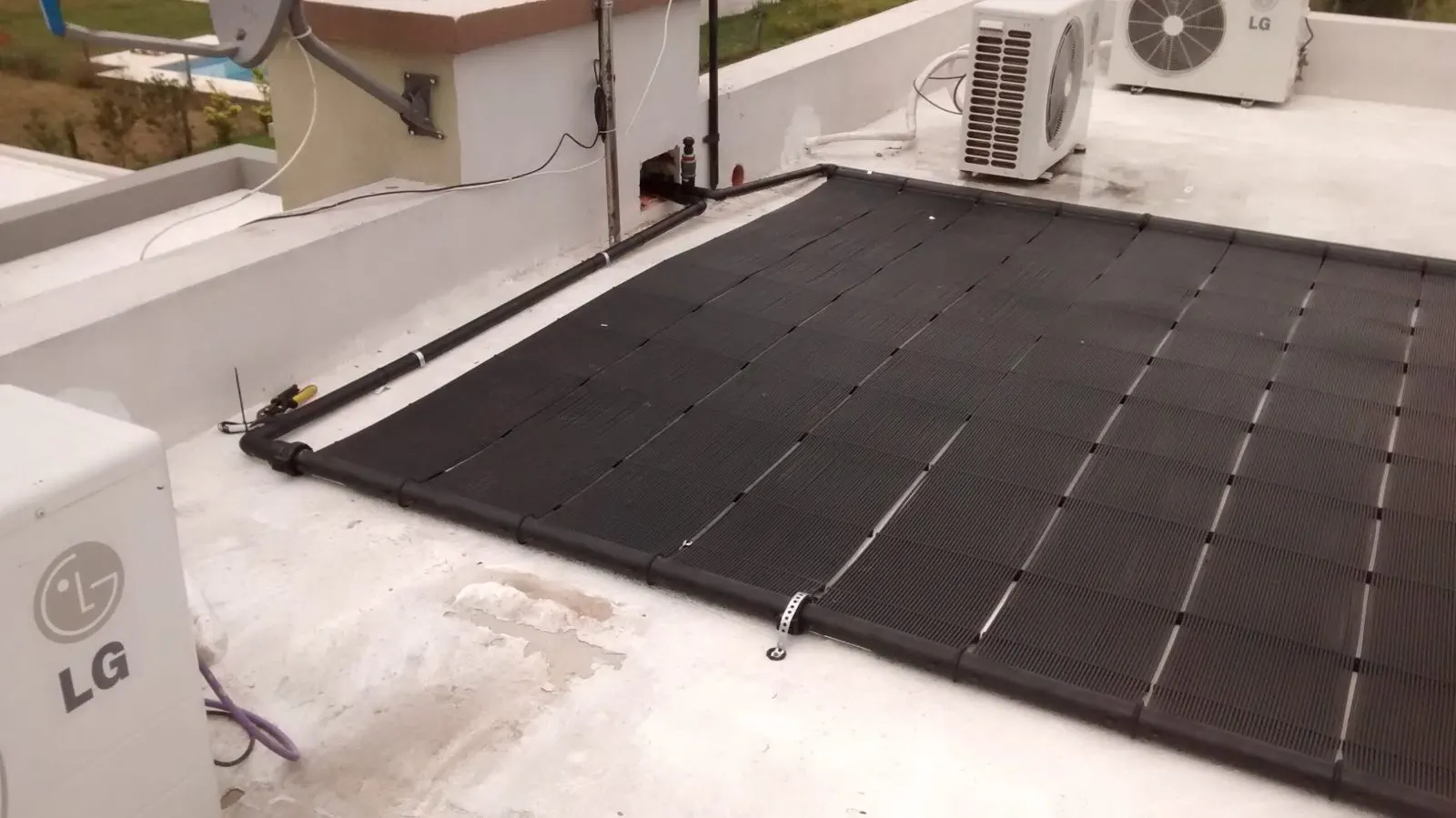
- The pool’s own filtration pump sends part of the water it is already moving up to a field of solar collectors.
- The water passes through them, picks up the heat the sun is giving that surface, and returns to the pool a little warmer.
- Repeat that for the hours of daylight, every day, and the whole volume comes up and stays up.
- An automatic valve decides when it is worth sending water to the collectors and when it is not. That is the only moving decision in the system.
No boiler, no gas, no refrigerant, no compressor. Nothing that can break expensively.
What makes the difference: this is calculated, not sold from a catalogue
This is where a system that works parts company with one that disappoints, and it is the part almost nobody will explain to you.
The collector area is sized at between 70 % and 100 % of the water surface area. That is not a brochure figure: it is the range within which the system delivers what it promises. Where exactly you fall inside it depends on four things — the orientation and tilt of wherever the collectors go, the shade they catch through the day and through the year, the temperature you want to reach, and the months you want it in.
Installing less area than the pool needs is the most common mistake and the most expensive one, because it does not show on the day of installation. It shows in May, when the water does not come up. And by then everything is already on the roof.
I do the design myself. I calculate and size the system from your pool’s own parameters — surface, volume, orientation, shade, how you intend to use it — then install it and commission it. I taught this subject in Buenos Aires before I came to install it here, and that is why the calculation is never delegated and never copied off a table.
The two accessories that change everything
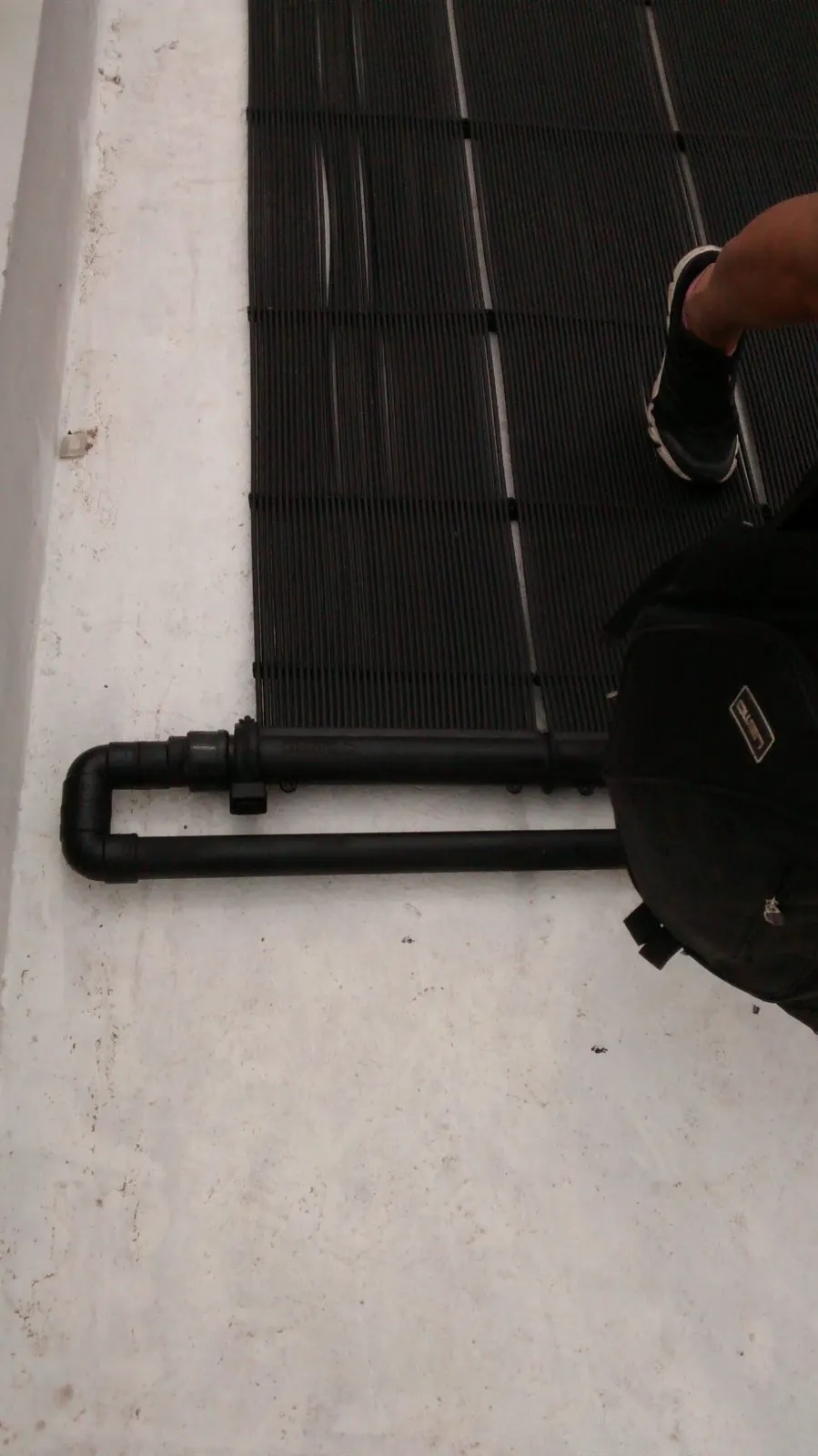
A solar field on its own works. A solar field with these two works properly, and they cost a fraction of the installation.
The thermal blanket
A pool loses most of its heat at night, through the surface, by evaporation. A thermal blanket stops that. It is the single cheapest thing you can do for a pool’s temperature, and it is what keeps the heat you gathered during the day instead of handing it back to the sky at three in the morning. It also cuts water loss and keeps leaves out.
We work with the blanket as part of the system, not as an optional extra, because the sizing assumes it is there. Without one you need more collector area for the same result — which is to say, the blanket is the cheapest square metres you will ever buy.
Automatic temperature control
Two sensors — one in the water, one at the collectors — and a motorised valve. The control sends water up only when the collectors are genuinely hotter than the pool, and stops when you have reached the temperature you set. You never touch it, it never overheats the pool in August, and it never wastes pumping on a cloudy afternoon.
This is the difference between a system you use and a system you end up ignoring.
What it does and what it doesn’t. Plainly
We would rather tell you now than afterwards:
- Yes: a comfortable swimming season from April to October on the Costa Cálida, with the system correctly sized and the blanket in use.
- Yes: no fuel cost and no expensive maintenance.
- It is not a boiler. Four overcast days in a row and the water drops. One or two days of sun and it comes back, without you having spent anything. It follows the weather rather than ignoring it.
- It will not let you swim in January in an uncovered pool. Anyone who tells you otherwise with solar collectors alone is selling you smoke.
- It needs somewhere sunny. A flat roof, a terrace, a pergola, the garage roof or a purpose-built frame. If there is not enough sunlit surface, we say so and we do not do it.
If you want it year round: solar plus backup
If what you want is a pool available in the winter months too, solar is still the right base — it just is not the whole answer. The sensible arrangement is solar doing the heavy lifting for eight or nine months, with a heat pump covering the edges of the season and the cold spells.
That way the backup runs a fraction of the hours it would run on its own, which is what keeps the electricity bill sane. A heat pump asked to heat an uncovered pool through a Spanish January, unaided, is an expensive machine to own. Combined with solar and a cover, it is a reasonable one. We design the two together, or we design the solar so the backup can be added later without redoing anything.
What it does for the property
Two things, and they are worth separating.
If you let the property, the heated pool is the difference between a June-to-September listing and an Easter-to-November one. Those shoulder weeks are the ones with no competition and real demand, and «heated pool» is one of the few phrases that moves a booking. The heating itself adds nothing to the running cost of those extra weeks, which is not something you can say about air conditioning.
If you are going to sell one day, a solar-heated pool reads differently from an unheated one: a buyer sees an amenity with no bills and no service contract behind it. And unlike a gas pool heater, there is nothing a surveyor is going to flag.
And if you are doing none of those things and simply live here, the honest answer is the best one: it is the difference between owning a pool and using one.
Installation, maintenance and service
- Design and sizing from your own pool’s figures, with the shade assessed on site. You get the reasoning, not just a price.
- A fixed written quote before anything starts, itemised so you can compare it with anybody else’s.
- Installation and commissioning by us, with the system left running and the control set with you there.
- The guarantee required by law on both materials and installation. Not a marketing promise — the legal one, in writing.
- Maintenance is minimal: essentially the same care the filtration already gets, plus draining the collectors before a hard frost where that applies.
- We repair other people’s installations too. If you have collectors that never worked properly, that is often a sizing or a control problem rather than a broken panel, and it is worth diagnosing before replacing anything.
Everything else about the pool — filtration, leaks, opening and closing the season — is on our swimming pools page.
Frequently asked questions
How much collector area does my pool need?
Between 70 % and 100 % of the water surface area. Where you fall in that range depends on orientation, tilt, shade, the temperature you want and the months you want it in. It is calculated for your pool, not estimated.
How much will it add to the electricity bill?
Almost nothing. The water is moved by the filtration pump you already run every day; the heat itself is free. There is no fuel and no separate appliance drawing power.
What happens if there are several cloudy days?
The water cools. With a thermal blanket on, it cools slowly, and one or two sunny days bring it back at no cost. It is a system that follows the weather rather than fighting it.
Does it mean building work?
Normally no. The collectors go on a roof, a terrace, a pergola or a frame, and they connect into the existing filtration circuit at the plant room. What has to be checked is where the pipe run goes and whether the surface will take the mounting.
Are they very visible?
They can usually be placed out of the eye line — a flat roof, behind a parapet, over a garage or on a pergola that earns its keep as shade. Where they go is part of the design, and it is discussed before anything is ordered.
How long does it last and what maintenance does it need?
There is nothing in it that wears the way a boiler does: no combustion, no compressor. Maintenance is essentially what the filtration already gets, plus draining the collectors before a hard frost where that applies.
I already have panels and the pool does not get warm. Will you look at it?
Yes, and that is a call we get often. It is usually one of three things: not enough collector area for the pool, no automatic control, or no thermal blanket. All three are diagnosable before spending anything.
Does it work for a community, hotel or gym pool?
Yes, and the economics are usually better, because those pools are used for more of the year and the fuel saving is larger. For a community we provide a written report suitable for putting to the owners’ meeting.
Where we work
The Costa Blanca north and south, the Mar Menor and Cartagena, Mazarrón, Águilas, inland Murcia and the Almería Levante around Mojácar and Vera. Town by town on service areas.
Send us the pool’s dimensions and a photograph of the roof or terrace, and we will tell you whether it is viable and what area it would need. That costs nothing and commits you to nothing.